.avif)

What is a shift schedule?
A shift schedule (Dienstplan) sets out in binding form which employee works on which day and at what time – including start, end, break and shift assignment. That makes it the central instrument for concrete, time-based staff scheduling in a business. Unlike a shift plan (Schichtplan) or a work schedule (Arbeitsplan), a shift schedule does not just describe structures or activities, but the actual assignment of people to working hours.
How it differs from a shift plan, a work schedule and a deployment plan
Below you will find the key terms set side by side. The table shows what each plan governs, how detailed it is and where it is used in day-to-day work.
| Type of plan | Core definition | What is being planned? | Link to time? | Link to individuals? | Link to tasks? | Typical use |
|---|---|---|---|---|---|---|
| Shift schedule (Dienstplan) | Concrete, binding allocation of employees to specific working days, times and shifts. | Working hours of individual employees | Very high – they are set concretely | Yes – employees are assigned by name | Partly (e.g. area or station), but not in detail. | All industries: hospitality, care, manufacturing, retail, administration |
| Shift plan (Schichtplan) | A business's basic shift system, without any assignment to individuals | Shift models (early/late/night), rotations, time blocks | High – shifts are defined in time, but not tied to individuals | No no assignment of individuals | Nopurely a time structure. | Areas with shift operations: industry, care, logistics, call centres |
| Work schedule (Arbeitsplan) | Description of the activities, work steps and processes of a role or a process | Tasks, processes, responsibilities | Low – times are barely defined, if at all | No– no specific individuals. | Very high– the focus is on tasks | Manufacturing, skilled trades, care, administration, quality assurance. |
| Deployment plan (Einsatzplan) | Umbrella term: a plan for allocating who is deployed when and where … often a combination of shift schedule and task planning | Duty times, places of work, areas of responsibility | Medium to high – depending on how it is set up | Yes– employees are usually named | Medium– depends on the industry | Multi-site businesses, job sites, care facilities, field service. |
The legal framework: which laws apply to shift scheduling?
Even though there is no single “shift schedule act” in Germany, shift scheduling does not happen in a legal vacuum. Whenever employers allocate working hours, they have to take various areas of law and sets of rules into account. The point of these requirements is not bureaucracy but the protective function of employment law: fair working hours, sufficient rest breaks and predictable working conditions.
The Arbeitszeitgesetz (ArbZG, the German Working Hours Act): the basis of all planning
The German Working Hours Act is the most important set of rules for any shift schedule. It lays down how long employees may work each day, what breaks have to look like and how much recovery time is required between two shifts. In practice, this means:
- A shift schedule may never set more than 8 hours of daily working time (with exceptions of up to 10 hours, if the time is compensated with time off within 10 hours).
- There must always be at least 11 hours of rest between two shifts.
- Breaks have to be scheduled as a firm commitment – not simply taken “when there is a chance”.
In short: the ArbZG defines the guard rails within which all planning has to take place. A shift schedule that breaches them is unlawful and, in case of doubt, not binding.
The employer's right to give instructions, and its limits
Under § 106 GewO (the German Trade Regulation Act), the employer generally has the right to determine working time and place of work – provided nothing else has been agreed. This right to give instructions is not unlimited, though. The employer always has to weigh up what the business needs against what is reasonable for employees.
Employment contract, collective agreement or works agreement: what they say comes first
When an employer exercises its scheduling authority, it always has to consider which requirements exist outside the statutory framework and which other arrangements take precedence:
- Employment contract: Some employment contracts define fixed working time models or specify how flexibly shifts may be moved.
- Collective agreement (e.g.): Collective agreements often contain very specific requirements on lead times, planning deadlines or shift models.
- Works agreements: In businesses with a works council, the shift schedule is subject to co-determination. No shift schedule may take effect without the works council's approval.
That means: shift scheduling is always a mixture of statute, correct interpretation and specific arrangements within the business.
Shift planning that finally works – with clockin
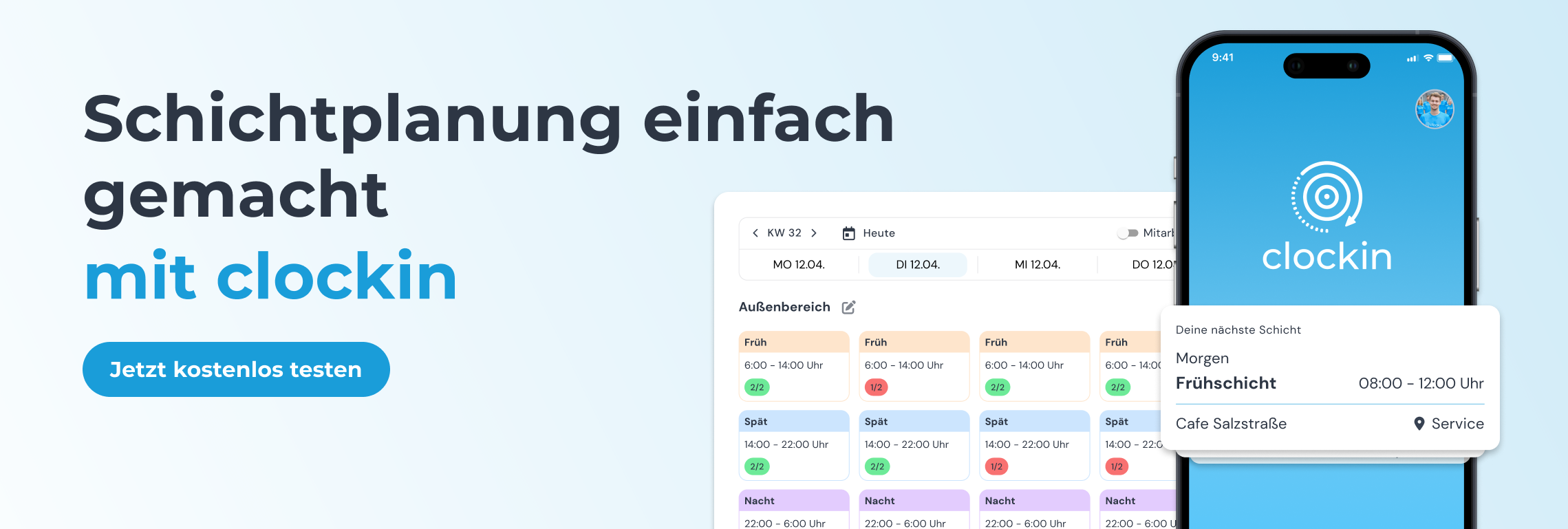
With clockin you plan shifts in seconds and cut coordination down to a minimum. The app automatically checks rest periods and working time limits, so your planning stays legally compliant at all times. Changes are sent to your team immediately – with no ring-arounds and no WhatsApp chaos.
The key benefits for you:
- Fast planning: assign shifts by drag & drop.
- Fewer mistakes: automatic checks of rest periods & working time requirements.
- Direct communication: employees see changes straight away in the app.
- More flexibility: open shifts can be picked up voluntarily.
- Everything connected: shift schedule & time tracking mesh perfectly.
Shift planning can be this simple – for you and for your team.
Case law: where the statute stays unclear – may a shift schedule be changed without asking?
Many questions around shift scheduling are not regulated in detail by statute, for example:
- How much notice a shift schedule has to give
- How short-notice changes may be
- Whether and for how long employees have to be reachable
Here, labour courts often take reasonableness as their guide. Judgments show, for example:
- There is no fixed statutory deadline for publishing shift schedules, but courts take the principle of reasonableness as their guide. Four days' notice is frequently regarded as appropriate.
- Short-notice changes are only permitted where there are urgent operational reasons (e.g. an employee suddenly falling ill). Without such reasons and without consent, changes are unlawful.
- Employees do not have to watch out for shift schedule changes in their free time, as long as there is nothing in the works agreement expressly allowing shifts to be fixed at short notice. A valid works agreement can make it possible for shifts to be set up to the evening before – in which case employees do have to be reachable.
- Overnight changes without informing employees are almost always inadmissible.
Case law therefore fills the gap left by the statute and makes it clear: shift schedules may not be changed arbitrarily – they have to be reasonable, justified and communicated in good time.
Can an employee refuse a shift schedule at short notice?
Yes – an employee may refuse a shift schedule that has been changed at short notice if the change is unreasonable or breaches legal requirements.
That applies, for example, where:
- the change is made without an urgent operational reason,
- the notice period is too short,
- rest periods or working time limits would be breached,
- or firm private commitments already exist and the change was communicated only very late.
In short: changes at short notice are only permitted with consent or in genuine emergencies.
.avif)
.avif)
.avif)